You’ve probably noticed: AI is everywhere. Chatbots answer customer questions. Automated systems handle bookings. Algorithms decide what content you see, which emails get flagged, and even which job applications make it to a human recruiter.
The technology works remarkably well—until it doesn’t.
That’s where human-in-the-loop comes in. It’s not a complicated concept, but it’s becoming one of the most important principles in business automation. Especially if you run a hotel, restaurant, or real estate agency in Malta where reputation and personal service actually matter.
What Does Human-in-the-Loop Actually Mean?
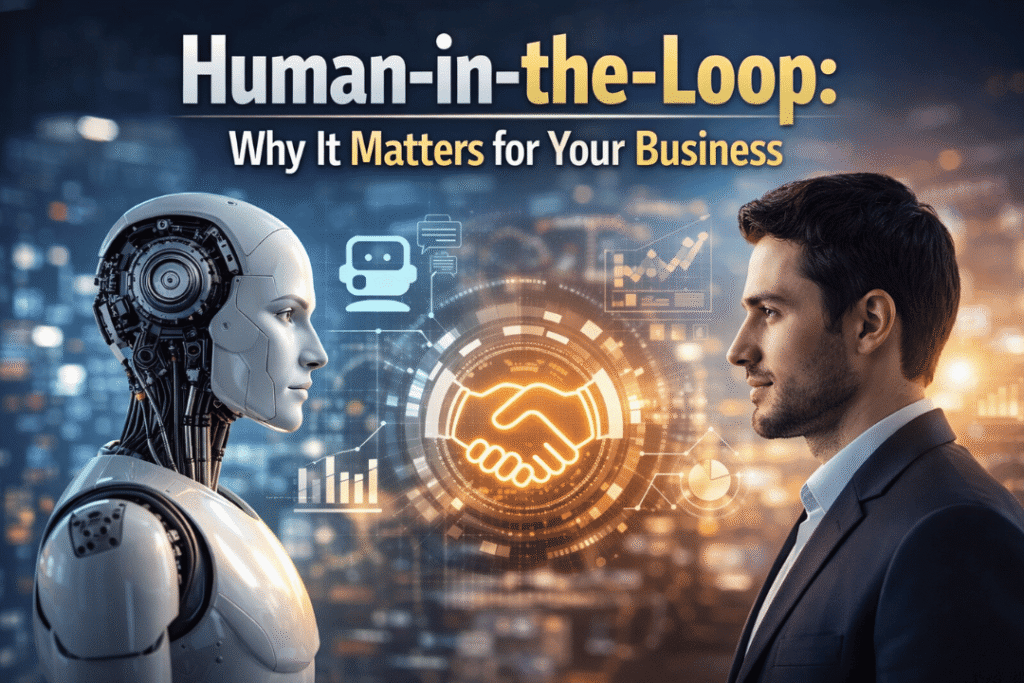
Human-in-the-loop (often shortened to HITL) is a simple idea: keep humans involved in automated processes, particularly at critical decision points.
Instead of letting AI systems run completely independently, you design them to pause, flag, or ask for human judgment when needed. The automation handles the routine and predictable work. People handle the nuanced, sensitive, or unusual situations.
Think of it as a partnership rather than a replacement. The AI does the heavy lifting. Humans provide the oversight, judgment, and final say.
In practice, this might look like:
- Your booking system automatically confirms standard reservations but flags unusual requests for staff review
- Customer service automation answers common questions instantly but escalates complex complaints to your team
- AI drafts responses to reviews, but a person approves them before posting
- Automated pricing adjusts based on demand, but major changes require manager approval
The system works faster than any human could alone. But it never makes important decisions without human verification.
Why This Matters More Now Than Ever
Five years ago, business automation was relatively simple. You automated straightforward tasks with clear rules: send confirmation emails, update spreadsheets, schedule appointments.
Today’s AI systems are far more capable—and far more complex. They can generate human-like text, make judgment calls, analyze sentiment, and even create content. This power is incredibly useful, but it also introduces new risks.
The Problem With Full Automation
When you remove humans entirely from automated processes, several things can go wrong:
Context gets lost. AI doesn’t understand that your regular guest always requests a quiet room, or that the “angry” email is actually from a customer who just has a direct communication style. It processes patterns, not relationships.
Edge cases break systems. Automation handles normal situations beautifully. But business is full of exceptions: the wedding party that needs special arrangements, the property viewing that conflicts with maintenance work, the guest with dietary requirements your system hasn’t seen before.
Mistakes happen publicly. When automated customer service goes wrong, it doesn’t just affect one interaction—it often happens in public reviews, social media, or in front of other customers. Recovery becomes exponentially harder.
Trust erodes quickly. Customers increasingly notice when they’re talking to automated systems. If those systems make mistakes or can’t handle their specific situation, frustration builds fast. One poor automated interaction can undo months of good service.
A Real Malta Example: Hotel Guest Services
Consider a boutique hotel in Valletta using AI-powered guest communication. The system handles hundreds of interactions smoothly: check-in times, WiFi passwords, breakfast hours, local recommendations.
Then a guest messages: “My father just passed away. I need to cut my stay short and return to the UK immediately.”
A fully automated system might respond with the standard cancellation policy, perhaps even charging fees. Technically correct, but devastatingly tone-deaf.
A human-in-the-loop system flags this message immediately. Keywords like “passed away” and “immediately” trigger human review. Within minutes, a real staff member responds with condolences, waives all fees, and helps arrange airport transportation.
The automation still saved time—it handled the other 47 messages that came in that day. But human judgment prevented a PR disaster and, more importantly, treated a grieving guest with actual humanity.
Where Human Oversight Creates the Most Value
Not every automated process needs human involvement at every step. The goal is strategic placement of human judgment where it matters most.
High-stakes decisions. Anything involving significant money, legal implications, or customer trust should have human verification. Refund requests, booking cancellations, complaint resolutions, contract terms.
Emotional situations. Customer service automation should always route distressed, angry, or emotionally charged interactions to real people. AI can detect sentiment, but it can’t provide genuine empathy.
Brand-sensitive content. Automated social media responses, review replies, or public communications should get human approval before going live. Your reputation is too valuable to trust entirely to algorithms.
Complex problem-solving. When customers have multi-part questions, unusual situations, or need creative solutions, human thinking remains superior. Automation can gather information and suggest options, but people should make the final call.
Learning opportunities. When automated systems encounter situations they can’t handle well, that’s valuable feedback. Human review of these edge cases helps improve your automation over time.
Human-in-the-Loop: What This Looks Like in Practice
Implementing human-in-the-loop doesn’t mean abandoning automation benefits. It means designing smarter systems.
For a restaurant using automated reservation management:
- Standard bookings confirm instantly (automation)
- Large groups trigger staff review (human-in-the-loop)
- Special requests get flagged for kitchen notification (human-in-the-loop)
- Cancellations within 24 hours alert the manager (human-in-the-loop)
For a real estate agency using AI for inquiry responses:
- Property information questions get immediate answers (automation)
- Viewing requests auto-schedule from agent calendars (automation)
- Price negotiations route to the listing agent (human-in-the-loop)
- Complaints or concerns escalate immediately (human-in-the-loop)
The automation still handles 80-90% of the work. But the remaining 10-20%—the situations that really matter—get proper human attention.
The Competitive Advantage
Here’s what many businesses miss: human-in-the-loop isn’t just about preventing mistakes. It’s actually a competitive advantage.
Your competitors are either doing everything manually (slow, expensive, inconsistent) or automating everything (fast, cheap, but impersonal and error-prone).
You’re doing something smarter: combining the speed and efficiency of automation with the judgment and care of human oversight.
Customers notice. They get instant responses to simple questions. But they also get genuine human attention when situations get complicated. They experience the best of both worlds.
Your team notices too. They’re not drowning in repetitive tasks anymore. They’re spending their time on work that actually requires human skills: solving unique problems, building relationships, making judgment calls.
The Bottom Line for Malta Businesses
If you’re in hospitality, real estate, or running a restaurant in Malta, you’re in a relationship business. Personal service, local knowledge, and genuine care are part of your value proposition.
Business automation and AI can help you scale that service—answer more inquiries, handle more bookings, respond faster, operate more efficiently. But only if you keep humans in the loop at the moments that matter.
The question isn’t whether to automate. It’s how to automate intelligently: building systems that amplify your team’s capabilities rather than replacing their judgment.
The businesses succeeding with automation aren’t the ones using the most advanced AI. They’re the ones who understand when to let technology work and when to let people lead.
That balance—that’s human-in-the-loop. And in a world where everyone’s rushing to automate everything, it might be your most important operational decision.
Want to implement intelligent automation that keeps humans in the right places? We help Malta businesses design human-in-the-loop systems for hospitality, real estate, and restaurants. Not maximum automation—smart automation that protects your reputation and empowers your team. Let’s discuss what makes sense for your business.